
Madison County Projected Versus Actual Release
A projected date is a calculation based on the sentence and credits then recorded. It is not proof that release occurred. An actual release date documents a completed move out of the agency's physical custody. Even then, the next status may be IDOC parole or mandatory supervised release, transfer to another agency, or community release. A projected discharge date can be later than the prison-release date because discharge may mark the end of supervision.
Pretrial custody is different. A Madison County Jail detainee awaiting court action does not have a fixed sentence-based release date. A judge may order release, dismiss a case, or impose a sentence, while another warrant or detainer may still prevent physical departure. The court order states legal authority; the jail release sheet records when Madison County custody ended.
Find a Madison County Projected Release
Start with the holder, not merely the county where the case began. The live IDOC search accepts a last name, including a partial surname, an IDOC number, or a birth date in the format shown on the form. It is the state route for an Illinois prison sentence. The Madison County Jail page has no public person roster or date calculator, so county custody requires a phone, court, or records request.
- Identify custody. Determine whether the person is at Madison County Jail, an IDOC prison, another jurisdiction, or no longer confined.
- Read the court case. Use the Circuit Clerk search gateway for the sentence, mittimus, amendments, custody credit, and release orders.
- Search IDOC when applicable. Match identity fields and read the top-level offender status before looking at date fields.
- Transcribe the exact label. Projected parole, projected discharge, actual parole, and sentence-count discharge do not mean the same thing.
- Use the county fallback. Call the jail information line at 618-692-1064 or request an existing booking/release or custody-status record.
- Check again after the date. Confirm a completed release, transfer, parole start, or continued custody.
For a broad released-person path, the Madison County released-inmate search explains how sheriff, court, IDOC, VINE, federal, and immigration records fit together.
Illinois Credit Changes Release Dates
Illinois sentence calculation begins with the sentencing order and mittimus, the statutory term, qualifying jail credit, and directions on concurrent or consecutive terms. IDOC then applies the offense-date version of the law and any credit for which the conviction is eligible. The main statute is 730 ILCS 5/3-6-3. There is no single statewide “good time percentage.”
Specified categories, including first-degree murder, terrorism, and natural-life terms, can require service without sentence credit. Enumerated serious violent, sexual, and firearm offenses can limit credit to 4.5 days per month, often described as roughly 85 percent service. Listed serious drug offenses can limit credit to 7.5 days per month, roughly 75 percent service. Other eligible determinate sentences may use a one-day-for-one-day baseline, subject to exclusions, revocation, restoration, programs, and the law tied to the offense date.
Never apply a percentage from an arrest charge. Use the conviction statute, commission date, final sentence, jail credit, and concurrent or consecutive treatment. Arrest charges may be changed or dismissed. The IDOC calculation, not an informal arithmetic estimate, is the operative state record.
The Illinois sentence-credit statute is shown in the matching source capture.
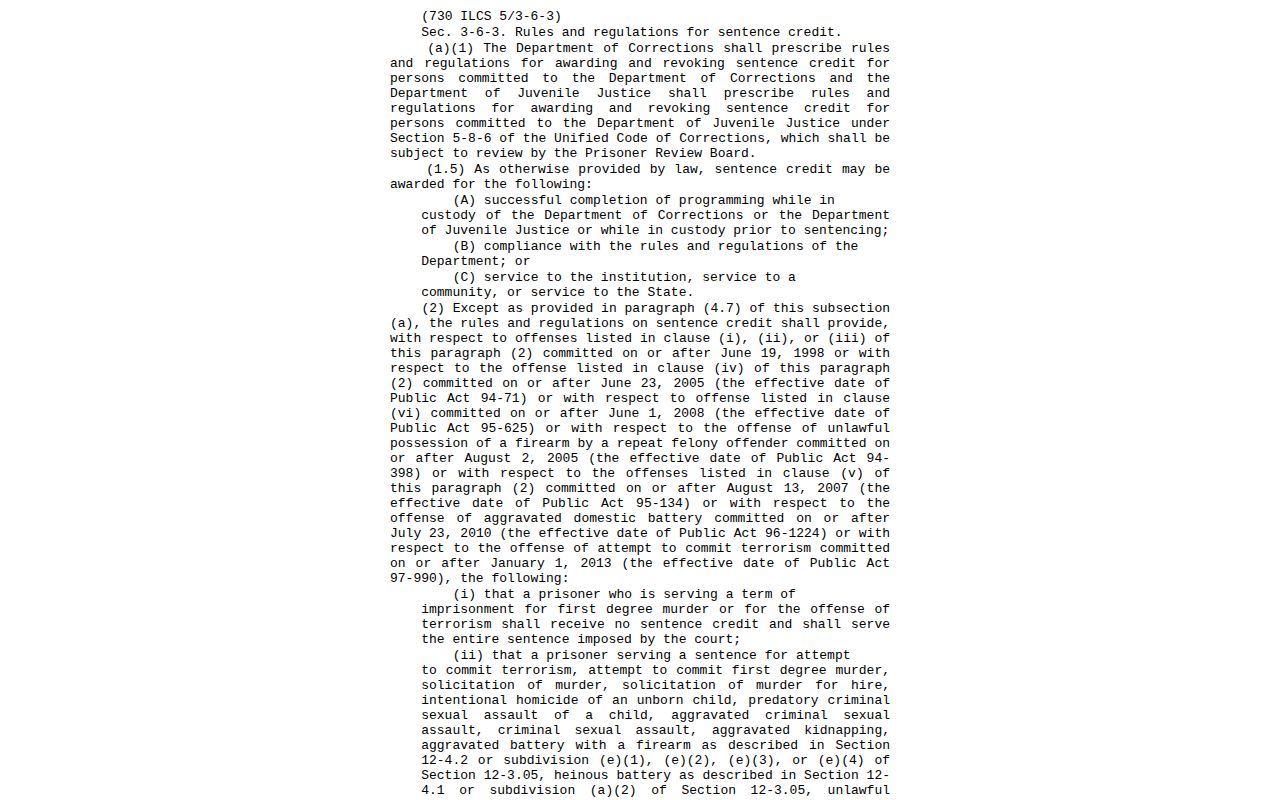
The statute's separate tiers are why one percentage cannot be used for every Madison County conviction.
Why Madison County Release Dates Move
IDOC Directive 01.07.400 explains that Records calculates projected and mandatory dates for determinate sentences. Credit may be revoked or restored. Time outside supervision after escape, an MSR violation, or certain release periods can alter the mandatory date. Consecutive terms are aggregated. Indeterminate cases instead use projected minimum and maximum dates, so their fields require a different reading.
| Factor | Possible effect | Best verification |
|---|---|---|
| Corrected jail credit | Moves the sentence calculation | Amended order and IDOC Records |
| New or consecutive sentence | Adds or aggregates custody time | Court mittimus and sentence blocks |
| Credit loss or restoration | Moves the projected date | IDOC computation |
| Program credit | May reduce time if legally eligible | IDOC record under applicable law |
| Detainer or outside warrant | May change destination without ending custody | Holding and receiving agencies |
| Violation or escape time | Can alter mandatory-date treatment | IDOC Field Services and Records |
| Amended court order | Changes the legal sentence input | Signed court order |
A detainer is another agency's notice that it may assume custody. Thus, Madison County or IDOC can record a release while the person remains confined elsewhere. The safest wording names both the agency left and the destination.
County and prison calculations should not be blended. Madison County jail staff apply local custody records and court orders to a county term, but the county publishes no online calculator. Presentence custody credit is set through the sentencing process and supplied to IDOC when a person receives a prison term. County-jail good-behavior provisions may also apply to an eligible local sentence. Because the offense, order, credit, holds, and agency all matter, the jail and court must confirm the local date instead of relying on a statewide prison estimate.
Read Madison County IDOC Fields
IDOC top-level fields can include Offender Status, Location, Admission Date, Parole Date, Projected Parole Date, and Projected Discharge Date. A supervised record may show PAROLE, a parole district, an actual parole date, and a later projected discharge. A current record can show IN CUSTODY along with both projected parole and projected discharge dates.
Sentence blocks list items such as mittimus, class, count, offense, custody date, sentence, county, and whether that count is discharged. Do not mistake “SENTENCE DISCHARGED?: YES” on one count for a final release. The overall offender status and all active counts control the interpretation.
Maintenance adds another limit. The live search warns that it can be unavailable while records are updated. A temporary no-result should lead to a later search and the telephone fallback, not a claim that custody ended. Identity matching also matters when surnames are common. An IDOC number is stronger than a name alone, while birth date and sentence county help distinguish two records. Written verification is appropriate when a dated agency statement is needed.
Projected parole and projected discharge answer different questions. The first anticipates transition from institutional custody to community supervision. The second anticipates the end of the full sentence and supervision track. A person can therefore have an actual parole date, remain under IDOC authority in a named parole district, and still show a future projected discharge date. When several sentence counts appear, compare each count's custody date and discharged flag with the top-level status. This prevents an older completed count from being mistaken for the controlling sentence.
Determinate and indeterminate cases also use different calculations. IDOC Directive 01.07.400 describes projected and mandatory release dates for determinate terms, while indeterminate terms receive projected minimum and maximum dates. Consecutive sentences are combined for calculation, and the MSR term follows the most serious felony or the longest applicable statutory enhancement. Those rules are why adding a stated sentence to an admission date will often produce the wrong answer. The official computation accounts for inputs that a public result may only summarize.
An official IDOC result example demonstrates the current-custody layout.
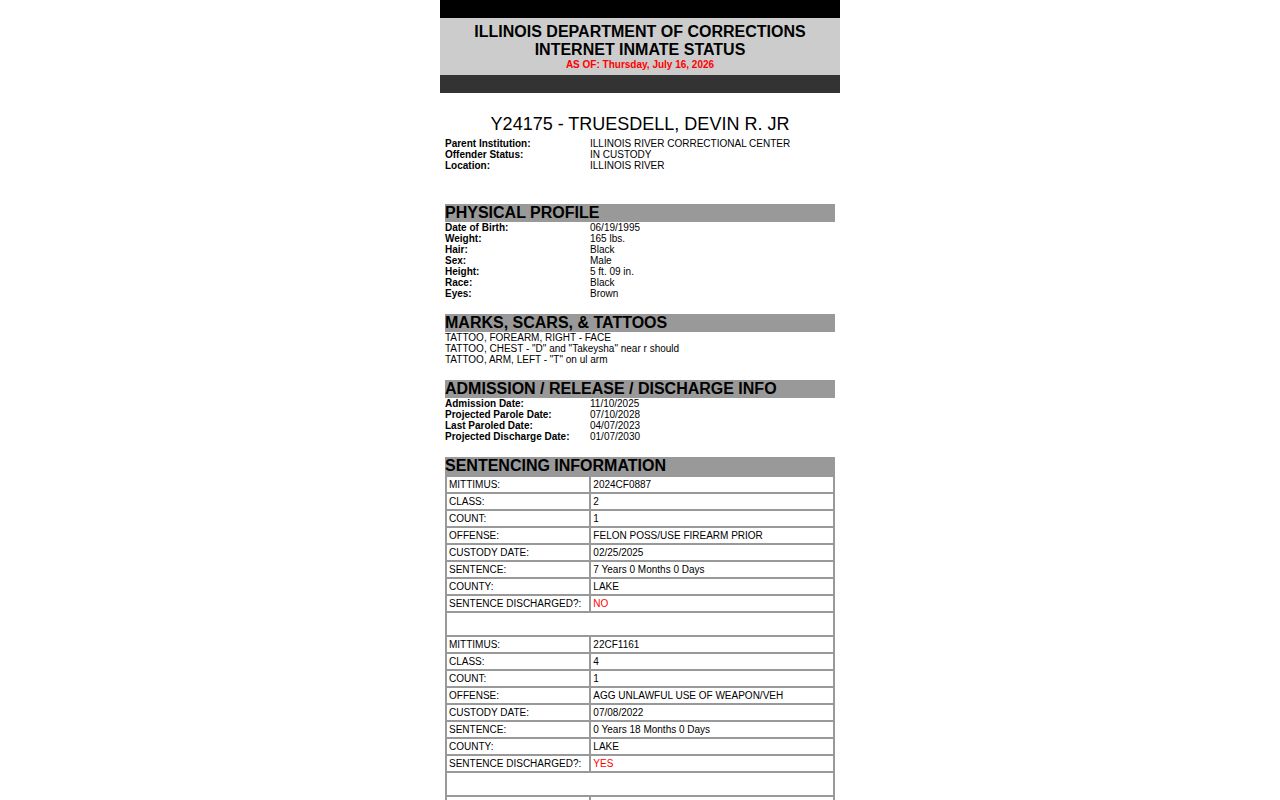
The example is useful only for field labels and layout; it is not evidence about another person.
Confirm a Madison County Release
Check the relevant agency after the projected day. For Madison County Jail, ask for the actual release time, authority, and destination. For IDOC, read the current offender status and actual parole or discharge field, then seek written verification when a precise legal record is needed. The IDOC public fallback number is 217-558-2200, and written verification is routed to the Public Information Office, 1301 Concordia Court, P.O. Box 19277, Springfield, IL 62794-9277.
Illinois VINE can provide a person-specific custody alert if registration occurs while the selected person is in custody. An alert is a prompt to check the source, not the release record itself. The Madison County VINELink inmate search explains the state registration channels and confirmation process.
For someone released to parole or MSR, the actual parole date begins a new status rather than ending all state authority. Read the projected discharge field and use IDOC Field Services for later warrant or discharge questions. This final custody-to-supervision check prevents a projected prison exit from being described as unconditional freedom.
The court docket can lag behind the signed order because Madison County says its public docket updates on Tuesdays and Fridays. The reverse can also occur: an order may appear before staff complete physical release. For exact timing, pair the signed order with the sheriff or IDOC custody record. That two-record method answers both why release was authorized and when the responsible facility recorded the transition.